Chess words for kids
Fork, pin, en passant, zugzwang: chess has a lot of strange words. Here are 60 of them, from A to Z, each in plain words, with a picture on the board for the tricky ones and a free lesson to learn it properly.
New to chess? Start with how to teach your child chess, or print every rule on one sheet: chess rules for kids.
A
- Attack
- A piece attacks another piece when it could capture it on its next move. Keep your pieces safe
B
- Back-row checkmate (back-rank mate)
- A king stuck behind its own pawns on the back row is checkmated by a rook or queen on that row. The pawns that were meant to protect the king leave it nowhere to go. Back-row checkmate
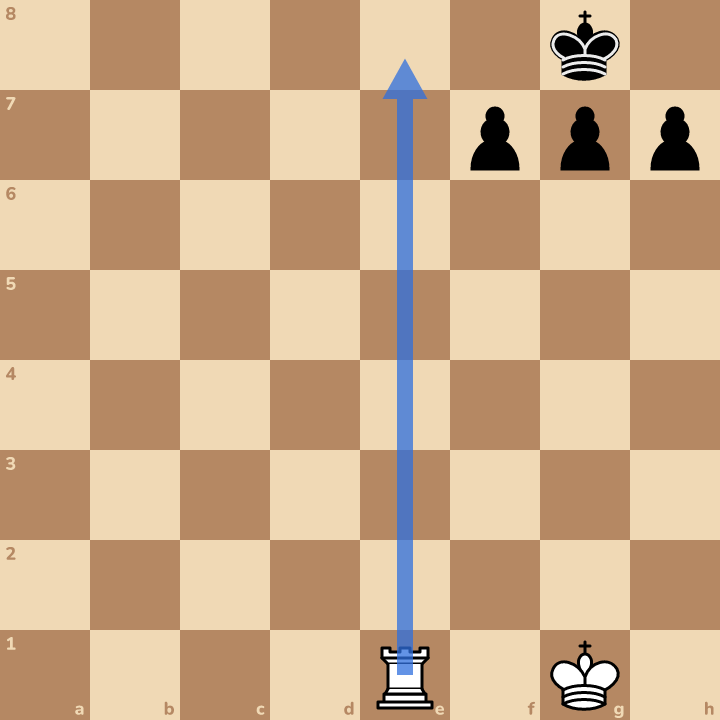
The rook goes to e8 and it's checkmate. The king can't step forward, because its own pawns are in the way. - Bishop
- A piece that moves any number of squares on a diagonal. Each bishop stays on squares of one colour for the whole game. Worth 3 points. How the bishop moves
- Blunder
- A big mistake, like leaving a piece where it can be taken for nothing. Everyone makes them, even grandmasters. Asking "can my piece be taken where it lands?" before each move stops most of them. Keep your pieces safe
C
- Capture (take)
- To land on a square with an enemy piece on it. The captured piece comes off the board. Every piece captures the way it moves, except the pawn, which captures one square forward on the slant. How to take pieces
- Castling (short and long castling)
- A special move of the king and a rook together. The king moves two squares towards the rook, and the rook jumps over to the square on the king's other side. You can castle on either side. Short castling (kingside, written O-O) uses the rook nearer the king. Long castling (queenside, written O-O-O) uses the rook on the queen's side: the king still moves two squares, and the rook travels three. It's allowed only if neither piece has moved, the squares between them are empty, and the king isn't in check, doesn't cross an attacked square and doesn't land on one. How to castle
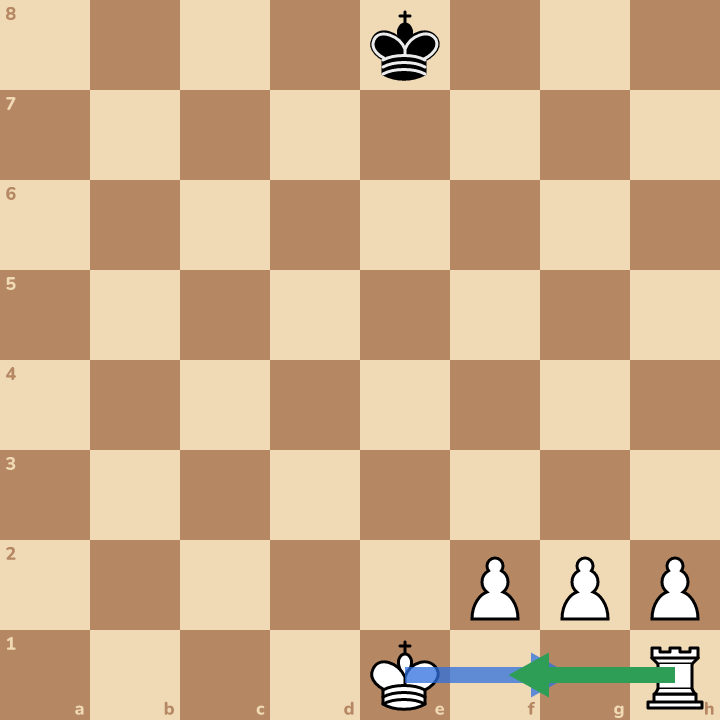
Short castling (O-O): the king moves two squares to g1 (blue), and the rook jumps over it to f1 (green). The king is tucked away behind its pawns. 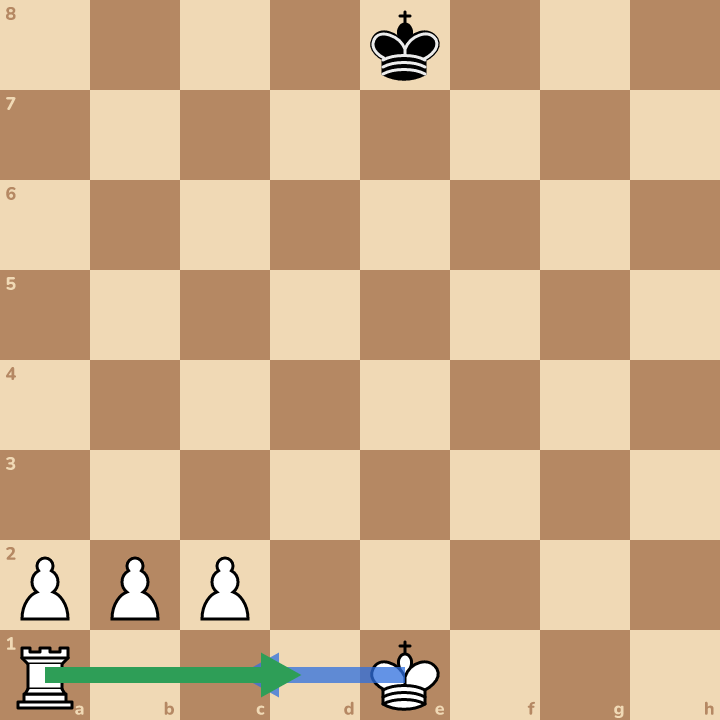
Long castling (O-O-O): the king moves two squares to c1 (blue), and the rook jumps over it to d1 (green). The b1 square must be empty too, but it doesn't matter if it's attacked: the king never crosses it. - Centre
- The four squares in the middle of the board: d4, e4, d5 and e5. Pieces in or near the centre can reach more squares, so both players try to control it. Why the centre matters
- Check
- When a king is attacked. The player in check must get out of it at once, in one of three ways: move the king, block the attack, or capture the attacking piece. What is check?
- Checkmate (mate)
- Check with no way out. Checkmate ends the game, and the player who gives it wins. What is checkmate?
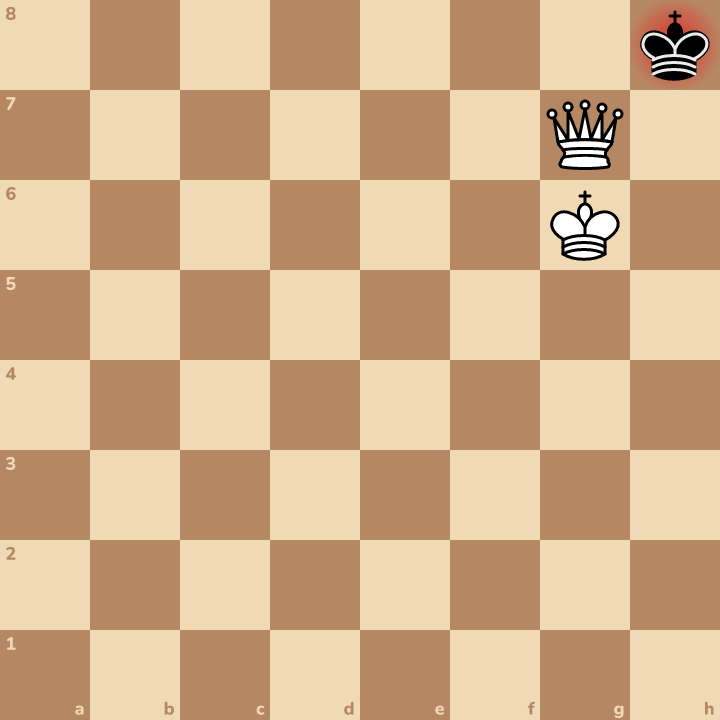
Checkmate. The queen attacks the black king, it has nowhere to go, and it can't take the queen because the white king guards her. - Column (file)
- A line of eight squares going up and down the board, from one player to the other. Each column has a letter, a to h. The board and square names
- Coordinates (square names)
- Every square has a name: the letter of its column, then the number of its row. The bottom left corner, from White's side, is a1, and e4 is the square in column e, row 4. The board and square names
D
- Develop
- To bring a knight or bishop out from its starting square at the start of the game, so it can join in. Developing your pieces and castling are the first jobs in every game. Develop and castle
- Diagonal
- A line of squares on the slant, all of one colour. Bishops and the queen move along diagonals. How the bishop moves
- Discovered attack
- One piece moves out of the way, and the piece behind it attacks. If the piece that moved attacks something too, there are two attacks at once. What is a discovered attack?
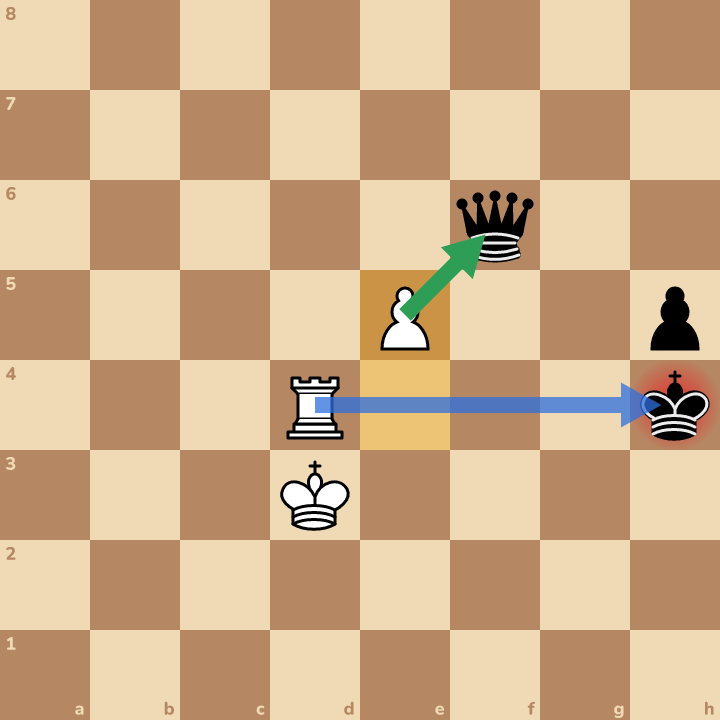
The pawn has just moved from e4 to e5. That opens the row for the rook, which now checks the king (blue), and the pawn attacks the queen (green). Black has to deal with the check, so White wins the queen. - Discovered check
- A discovered attack where the piece behind attacks the king. The other side must answer the check, so the piece that moved can often take something for free. Discovered check
- Double check
- Check from two pieces at once, usually from a discovered check. You can't block two checks or capture two pieces in one move, so the king has to move. Double check
- Draw
- A game that ends with nobody winning. Stalemate, not enough pieces to checkmate, the same position three times, and agreeing a draw all end the game this way. How a chess game ends
E
- En passant
- French for "in passing". If a pawn moves two squares and lands right beside an enemy pawn, that pawn may capture it as if it had moved only one square. It must be done on the very next move, or the chance is gone. What is en passant?
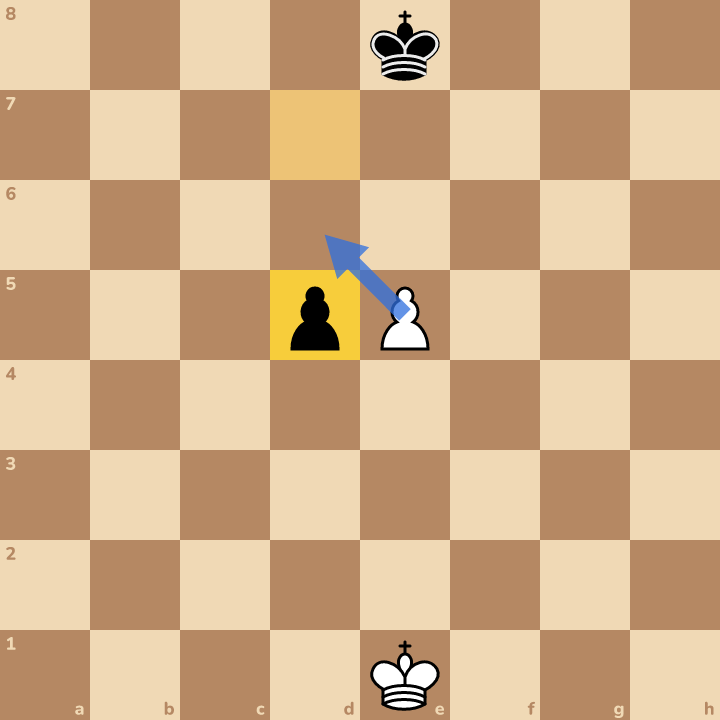
The black pawn has just moved two squares to d5. The white pawn captures it by moving to d6, and the yellow pawn comes off. - Endgame
- The end part of a game, when only a few pieces are left. Kings become strong pieces, and making a new queen is often the plan. King and pawn endgames
- Exchange
- Another word for a trade: you capture a piece and the other side captures one of yours back. Good trades
F
- Fianchetto
- Italian for "little flank" (say it "fee-an-KET-oh"). The pawn beside the bishop moves one square (g2 to g3, say), and the bishop goes to the square it left, g2. From there it looks along the longest diagonal, right across the board.
- Fifty-move rule
- If fifty moves go by for each player with no capture and no pawn move, a player can claim a draw. Three times the same, and fifty moves
- Fork
- One piece attacks two enemy pieces at once. Only one of them can move away, so the other one is lost. Knights are famous for forks. What is a fork?
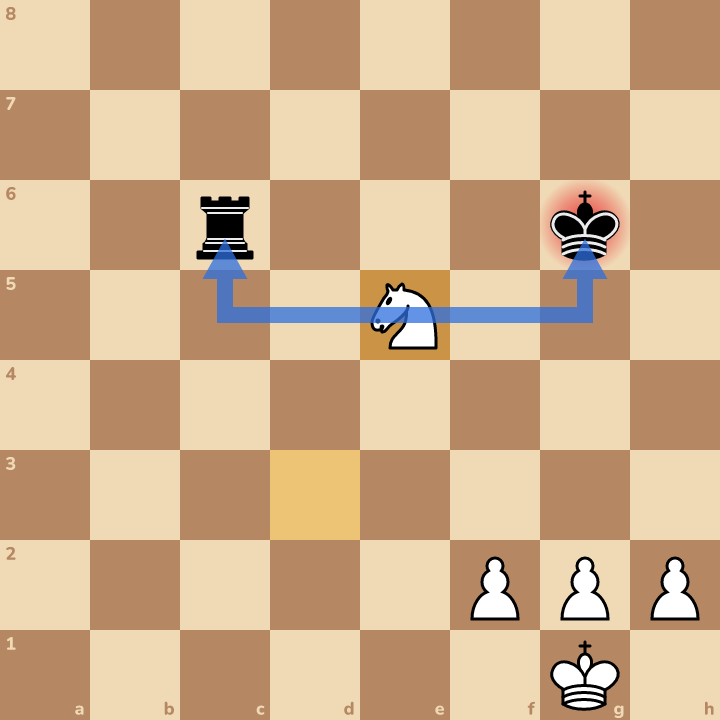
A knight fork. The knight checks the king and attacks the rook. The king must move, and then the knight takes the rook.
G
- Gambit
- Giving away a pawn, or sometimes more, at the start of the game, to get your pieces out faster or start an attack.
- Guard (defend, protect)
- A piece is guarded when one of your own pieces could capture back if it were taken. Keep your pieces safe
H
- Hanging (unguarded, loose)
- A piece that is attacked and not guarded, so it can be taken for free. Spotting hanging pieces, yours and theirs, wins more games for beginners than anything else. How to win a piece
I
- Illegal move
- A move the rules don't allow, like moving into check or moving a piece the wrong way. In a friendly game, take it back and play a legal move instead. Chess rules for kids
- Insufficient material (not enough pieces)
- When neither side has enough pieces left to checkmate, like a king against a king, or a king and one knight against a king. The game is a draw. Not enough pieces to checkmate
J
- J'adoube
- French for "I adjust" (say it "zha-DOOB"). Say it before you straighten a piece on its square, so everyone knows you're not choosing it to move. Good manners
K
- Key squares
- In a king and pawn ending, the squares where your king makes sure the pawn becomes a queen, whoever has to move. Key squares
- King
- The most important piece. It moves one square in any direction. If your king is checkmated, you lose, so it is never captured and has no points. How the king moves
- Kingside and queenside
- The two halves of the board. The kingside is the e to h columns, where the kings start; the queenside is a to d, where the queens start. Castling kingside (short) takes the king to g1, or g8 for Black; castling queenside (long) takes it to c1, or c8. How to castle
- Knight
- A piece that jumps in an L shape: two squares one way, then one to the side. It is the only piece that can jump over others. Worth 3 points. How the knight moves
L
- Ladder checkmate
- Two rooks (or a rook and queen) take turns checking the king, one row at a time, until it is pushed to the edge and checkmated. It looks like climbing a ladder. Ladder checkmate
M
- Mate in one
- A puzzle, or a position in a game, where you can checkmate in one move. "Mate in two" means in two of your moves, whatever the other side does. Checkmate in one
- Middlegame
- The middle part of a game, after the pieces have come out and before the endgame. Most attacks and tricks happen here.
N
- Notation
- The way chess moves are written down, using the square names. Nf3 means a knight moves to f3, and exd5 means the e-pawn takes on d5. Chess notation
O
- Opening
- The start of a game, when both sides bring their pieces out. Good openings put a pawn in the centre, develop the knights and bishops, and castle. Develop and castle
- Opposition
- When two kings face each other with one square between them. Neither king can step next to the other, so whoever has to move must give way. The side that does not have to move "has the opposition", and in king and pawn endings that often decides the game. What is the opposition?
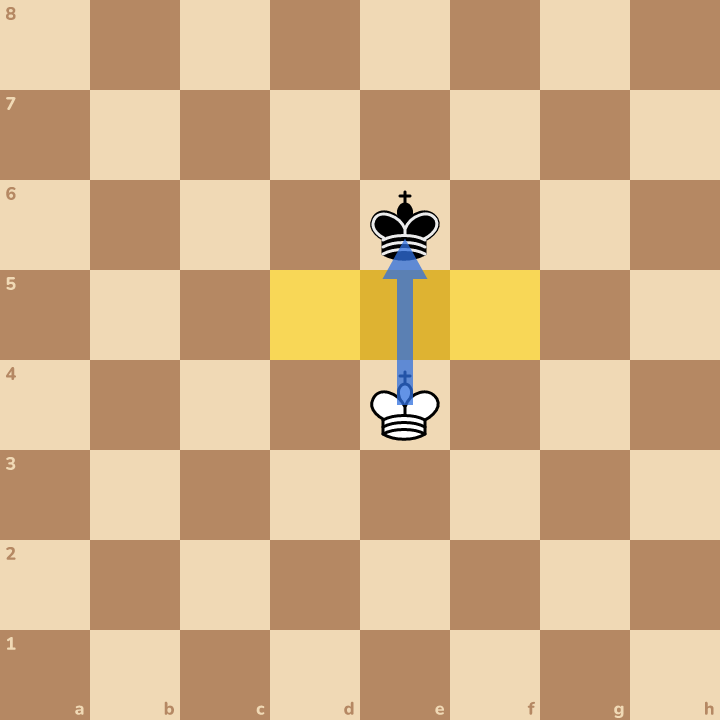
The kings face each other with one square between. Neither king can step onto the yellow squares, so White, to move, must give way. Black has the opposition.
P
- Passed pawn
- A pawn with no enemy pawns in front of it or on the columns beside it, so no pawn can stop it on its way to becoming a queen. What is a passed pawn?
- Pawn
- The smallest piece. It moves one square straight forward (two on its first move) and captures one square forward on the slant. It never moves backwards. Worth 1 point. How the pawn moves
- Pin
- A piece can't move, or shouldn't, because a more important piece is behind it on the same line. If the king is behind it, moving is against the rules. What is a pin?
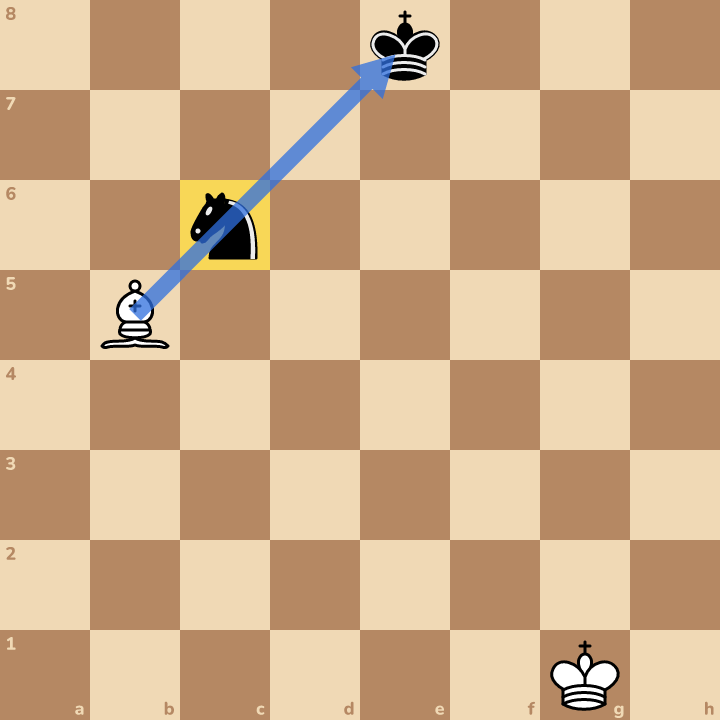
The knight is pinned. If it moved, the bishop would be checking the king, and that's not allowed. Pinned pieces are stuck, so attack them again. - Points (piece values)
- How much each piece is worth, to help decide whether a trade is good: pawn 1, knight 3, bishop 3, rook 5, queen 9. What the pieces are worth
- Promotion
- When a pawn reaches the far side of the board, it becomes a queen, rook, bishop or knight. Almost everyone picks a queen. Pawn race: make a queen
Q
- Queen
- The strongest piece. It moves any number of squares along a row, a column or a diagonal. Worth 9 points. How the queen moves
R
- Rank
- Another name for a row. The board and square names
- Removing the defender
- Capturing or chasing away the piece that guards something, so you can take what it was guarding. Removing the defender
- Repetition (threefold repetition)
- If the same position comes up three times, with the same player to move, the game can be claimed as a draw. Three times the same
- Resign
- To give up the game because you know you will lose. The other player wins. Shake hands and say "good game". How a chess game ends
- Rook
- A piece that moves any number of squares along a row or a column. Worth 5 points. How the rook moves
- Row (rank)
- A line of eight squares going across the board, from side to side. Each row has a number, 1 to 8, counting from White's side. The board and square names
S
- Sacrifice
- Giving away a piece on purpose, to get something better back, like a checkmate or a bigger piece. Sacrifice to checkmate
- Skewer
- A pin the other way round: the more important piece is in front. When it moves out of the attack, the piece behind it is taken. What is a skewer?
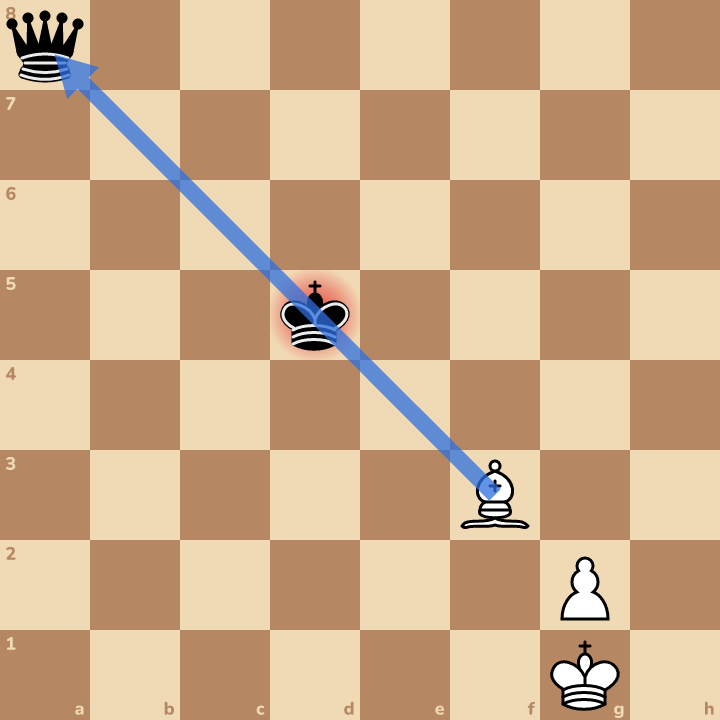
The bishop checks the king, and the queen is behind it. The king must move out of the way, and then the bishop takes the queen. - Smothered mate
- A checkmate by a knight, where the king is boxed in by its own pieces and has nowhere to go. Smothered mate
- Square of the pawn
- A quick way to tell whether a king can catch a pawn racing to become a queen: picture a square from the pawn to the far side. If the king can step inside it, it catches the pawn. The square of the pawn
- Stalemate
- When the player to move is not in check but has no legal move. The game is a draw. Watch out when you're winning: hemming in a lone king without giving check throws the win away. What is stalemate?
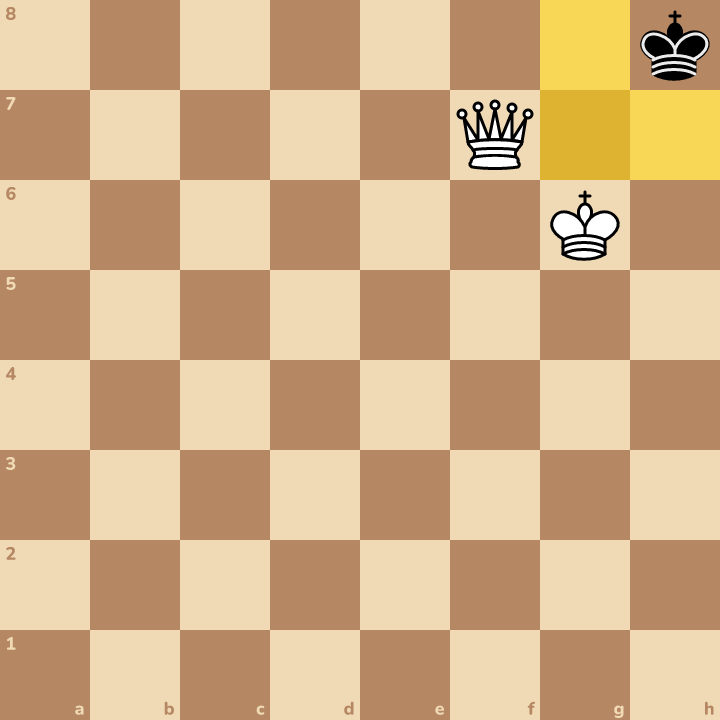
Black to move. The king isn't in check, but all three yellow squares are covered, and Black has no other piece. A draw.
T
- Tactic (trick)
- A short run of moves that wins something, like a fork, a pin or a skewer. Puzzles are the best way to learn them. Puzzle of the day
- Touch-move
- On a real board, if you touch one of your pieces, you must move it, and if you touch an enemy piece you can take, you must take it. So think first, then touch. Good manners
- Trade
- You capture a piece and the other side captures one of yours back. Count the points: a knight for a knight is even, but a rook (5) for a knight (3) loses 2. Good trades
Z
- Zugzwang
- German for "forced to move" (say it "TSOOG-tsvang"). Every move makes things worse, and you would rather pass, but in chess you can't. The opposition is one kind of it. What is the opposition?
My Chess Family in one minute
- A free chess app for children from age 4, teenagers too, and their families, made in the UK
- No chat: children can't type to anyone, only send eight friendly emotes
- No strangers: friends join only by a one-time code from a grown-up
- No ads, no purchases, no links out of the app
- A grown-up sees every lesson, puzzle and game
- Built around the UK Children's Code
- Works in a web browser, best on an iPad; families apply and we approve each one
More for parents: how to teach your child chess · chess rules for kids · printable chess board · free worksheets · free lessons